

Linen vs Cotton Tea Towels: Which Prints Better
Quick Summary
Cotton usually gives the sharper, more even print on tea towels for printing, while linen gives a textured, relaxed look that softens fine lines. The right choice depends on your design: cotton suits detailed artwork and small text, and linen suits bold graphics and rustic styles.
- Cotton's flat, tight weave keeps edges crisp and ink even on detailed designs.
- Linen's slubbed weave blurs thin lines and small type, so favor bold graphics on it.
- Linen sheds less lint, making it the better choice for drying glassware without streaks.
- Wash printed towels cold, skip bleach and fabric softener, and tumble dry low or air dry.
- Skipping a pre-wash is the most common cause of prints distorting after the first laundry.
Table of Contents
- Why Fabric Choice Changes Your Printed Tea Towel
- Linen vs Cotton: Fabric Weave, Texture and Surface Smoothness
- Print Quality Side by Side: Color Intensity and Fine Detail
- Absorbency, Lint and Drying Performance for Everyday Use
- Pre-Treatment, Shrinkage and Washing After Printing
- Cost and Sourcing: Blank Tea Towels for Printing and Wholesale Runs
- Choosing the Right Tea Towel for Your Print Project
- Frequently Asked Questions
Why Fabric Choice Changes Your Printed Tea Towel
Last Updated: November 17, 2026
Choosing between linen and cotton for a printed tea towel sounds like a small decision. It isn't. The fabric decides how crisp your print looks, how it holds up in the wash, and whether the towel still feels good after fifty uses. The fabric you pick shapes the result more than most buyers expect.
Here is the short answer: cotton usually gives the sharper, more even print, while linen gives a textured, relaxed look that many people love but that softens fine lines. Neither is "better" in every case. The right pick depends on the design you want and how the towel will be used.
Tea towels for printing come in a few common blank types. Most are plain weave cotton, flour sack cotton, linen-cotton blends, or pure linen. Each reacts differently to ink, heat and washing. Knowing those differences before you order saves money and disappointment later.
Linen vs Cotton: Fabric Weave, Texture and Surface Smoothness
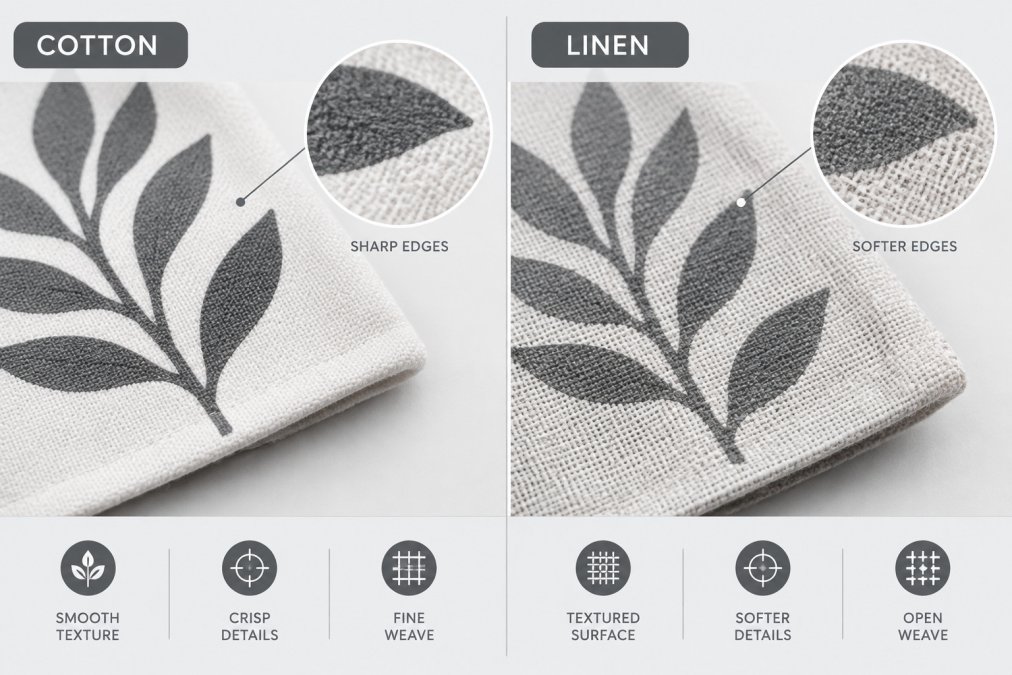
The weave is the first thing that separates these fabrics. Cotton tea towels typically use a tight, flat weave, which gives a smooth surface that takes ink evenly. Linen has a looser, slubbed weave with visible irregularities in the thread. Those irregularities are part of its charm, but they also break up fine lines.
Linen feels crisp when new and softens noticeably with washing. Cotton starts softer and stays consistent. If you want a towel that feels plush from the first use, cotton is usually the easier choice. If you like the rustic, lived-in feel, linen delivers it.
A common mistake is choosing linen for a design with thin lettering or small illustrations. The texture can make those details look fuzzy. For bold graphics and large type, linen works well. For detailed artwork, cotton is the safer bet.
Print Quality Side by Side: Color Intensity and Fine Detail
Most comparisons stop at "cotton is sharper, linen is softer." That is true often enough to be useful, but it does not tell you why, and it does not tell you whether your specific print method will behave the same way. Print quality on a tea towel is the product of three things: how smooth the fabric surface is, how much ink the fiber takes up, and how the ink sits on top of the weave. Change the method and the ranking can shift.
Start with surface geometry. A plain-weave cotton blank presents a relatively flat plane of interlaced yarns, so a print sits close to the surface and edges stay defined. Linen's yarns are thicker, less uniform, and slubbed, which means the surface rises and falls across the towel. Ink that crosses a slub or a gap between yarns has to bridge a small valley, and that is where fine lines blur and small type fills in. The effect is not random: it scales with how much of your design is thinner than the weave irregularity. A quarter-inch line survives on linen; a hairline serif does not.
Now layer in the method, because this is where most buying decisions actually go wrong.
Absorbency, Lint and Drying Performance for Everyday Use
Linen is well known for absorbency and quick drying. It pulls up water fast and releases it quickly, which makes it practical for drying dishes. Cotton absorbs well too, though it holds more moisture and dries a little more slowly.
Lint is a different story. Cotton tea towels can shed lint, especially in the first few washes. Linen sheds less, and that makes it a better choice for drying glassware, where lint leaves streaks. If you dry wine glasses or polished silverware, linen is the better fit.
For everyday kitchen use, both fabrics perform well. The practical difference shows up in what you do with the towel. Heavy spills and frequent washing favor cotton's softness. Frequent glass drying favors linen's low lint.
Pre-Treatment, Shrinkage and Washing After Printing
This is the part of the decision that buyers underestimate and printers lose money on. A tea towel is washed far more often than a t-shirt, so preparation and post-print care decide whether the print survives the first month. Treat this as a sequence, because each step affects the next.
Step five: wash and dry for longevity. Turn the towel inside out, wash cold with mild detergent, skip bleach and fabric softener, and tumble dry low or air dry. Heat is the main enemy of a print on either fiber, because repeated high heat fades pigment and cracks the ink film. Cotton generally tolerates repeated agitation better; linen becomes softer and can thin with heavy washing, so gentler cycles extend its life.
Watch out: skipping the pre-wash to save time is the single most common cause of a print that looks perfect on delivery and off-center or distorted after the customer's first laundry day.
Cost and Sourcing: Blank Tea Towels for Printing and Wholesale Runs
Be cautious with very cheap blanks. Thin, loosely woven cotton can look good in photos but wear quickly and print unevenly. Ask for a sample before committing to a large order. Feel the fabric, check the weave, and test a small print if you can.
Choosing the Right Tea Towel for Your Print Project
Match the fabric to the job. Use this as a simple guide:
| Project need | Best fabric | Why |
|---|---|---|
| Detailed artwork or small text | Cotton | Smooth surface keeps edges sharp |
| Bold graphics, large type | Linen or cotton | Both hold up; linen adds texture |
| Drying glassware | Linen | Lower lint, no streaks |
| Heavy everyday use | Cotton | Softer and more forgiving in the wash |
| Rustic or vintage look | Linen | Natural texture suits the style |
| Budget wholesale order | Plain cotton | Lower cost per towel |
If you are printing a family recipe or a gift, think about who will use the towel. A design meant for display may suit linen. One meant for daily use usually fares better on cotton.
Frequently Asked Questions
What's the best fabric for a tea towel?
For most kitchens, cotton is the best all-round choice for a tea towel. It absorbs water quickly, dries fast and washes well. Flour sack cotton is a popular option because its loose weave is soft and lint-light, though it can feel thinner. Linen dries faster and resists lint better than many cottons, but it costs more and feels stiffer at first. For printing, a tightly woven cotton or cotton-linen blend usually gives the sharpest image. Choose based on whether you want maximum absorbency, a more premium feel, or a lower price per towel.
How do you print on tea towels?
The most common methods for tea towels are screen printing, heat transfer and digital direct-to-garment or sublimation-style printing on suitable fabrics. Screen printing suits larger runs and bold colors. Heat transfer works well for small batches and detailed designs. Before printing, most printers wash the blank towel to remove sizing and reduce shrinkage, then press it flat. Ask your printer which method they use, because the fabric you choose must match that method to get a durable, crisp result.
Are linen towels better than cotton towels for printing?
Linen towels are not automatically better for printing. Linen has a more textured surface, which can make fine lines and small text look slightly softer, while tightly woven cotton often holds crisp detail and vivid color more evenly. Linen does dry faster and sheds less lint, which matters for drying glassware. If your design has bold shapes and solid color, linen works well. If it has fine detail or photographic elements, a smooth cotton weave usually prints more accurately.
Do linen tea towels shrink after printing and washing?
Linen and cotton can both shrink, especially on the first wash. Pre-washing blank towels before printing removes most of this movement and helps prevent the design from distorting. After printing, wash in cool water, avoid high heat in the dryer and let the towel air dry where possible. Heat-set or cure prints according to the ink manufacturer's directions, because under-curing is a common reason prints fade or crack after washing.


