

How to Price a Handmade Keepsake Quilt
Last Updated: October 26, 2026
Quick Summary
Keepsake quilt pricing means adding up every real cost behind a memory quilt, then adding a fair profit so the final number reflects the work inside it. Use the formula Materials + Labor + Overhead + Profit = Sales Price, and quote by finished size and garment mix rather than garment count alone.
- Representative starting prices run from $349.99 for a 42" × 42" baby quilt to $1,299.99 for a 106" × 106" king quilt.
- Price per square foot falls as size rises because setup work is roughly fixed per quilt.
- A worked 63" × 63" throw quote with one photo panel and embroidery totals $961.30.
- Custom memory quilts typically run 6-8 weeks from the business day after clothing arrives.
- Ask any maker for the price per square foot alongside the total to compare quotes for different sizes.
Table of Contents
- Why Keepsake Quilt Pricing Starts With Real Costs
- How to Price a Quilt to Sell Without Underselling Your Work
- Using a Quilt Pricing Calculator to Set a Sales Price
- Memory Quilt Size and Price: A Size-by-Size Comparison
- Custom Memory Quilt Pricing: What Drives the Number Up
- Turnaround, Deposits, and Revisions in Your Quote
- Order a Keepsake Quilt With a Quote You Can Trust
- Frequently Asked Questions
Why Keepsake Quilt Pricing Starts With Real Costs
A keepsake quilt pricing guide only works if it starts with the truth: these quilts cost real money to make.
Keepsake quilt pricing means adding up every real cost behind a memory quilt, then adding a fair profit so the final number reflects the work inside it.
Most guides quote a single number and skip the math. For a deeper breakdown, see why custom quilts are so expensive.
How to Price a Quilt to Sell Without Underselling Your Work
Most makers underprice because they forget to pay themselves; a low-priced quilt often loses money once labor enters the math.
The fix is a simple formula:
Materials + Labor + Overhead + Profit = Sales Price
Start with materials, add labor at a real hourly rate, add a share of overhead like machine wear and electricity, then add profit margin.
Charging only for fabric and thread leaves nothing for the hours of cutting, piecing, quilting, and binding. To benchmark your pricing, look at a custom heirloom quilt handcrafted by Johnson Heirloom.

The Itemized Pricing Worksheet
Use this worksheet to build a quote line by line. Fill in your own numbers.
- Fabric from the customer: $0 (customer supplies garments)
- Supplemental quilting cotton: cost per yard × yards needed
- Batting: cotton batting, priced per package or per yard
Add the lines, apply overhead and profit, and you have a defensible sales price.
What a Quote Should Include and Exclude
A clear quote protects both sides. State what is included and what is not, in plain words.
Include in the quote:
- Finished size and design style
- Number of garments needed
- Photo panels and embroidery, if any
Exclude from the quote:
- Shipping and insurance
- Rush fees
- Extra garments beyond the stated count
Spelling this out up front avoids awkward conversations and shows the buyer exactly what they are paying for.
Using a Quilt Pricing Calculator to Set a Sales Price
A quilt pricing calculator turns the worksheet into a fast, repeatable tool: enter materials, hours, and target margin, and it returns a sales price.
Run every quote through the calculator so your pricing stays consistent. A Small Business Administration guide to pricing products notes that consistent, cost-based pricing helps small makers protect their margins.
The calculator also shows where to cut: if labor is eating the price, a simpler design or smaller size lowers the number without slashing your rate.
Memory Quilt Size and Price: A Size-by-Size Comparison
Size drives price more than any other single factor: a bigger finished size means more fabric, blocks, quilting passes, and machine hours. But size and price do not move in a straight line.
The table below shows representative starting prices for common keepsake quilt sizes, based on a simple patchwork design with customer-supplied clothing, standard cotton batting, an all-over quilting pattern, and no photo panels or embroidery.
| Finished Size | Common Name | Approx. Square Feet | Representative Starting Price | Price per Square Foot | Typical Garment Count |
|---|---|---|---|---|---|
| 42" × 42" | Baby / lap | 12.25 | $349.99 | ~$28.57 | 8-12 baby items or 6-8 adult garments |
| 50" × 60" | Small throw | 20.83 | $449.99 | ~$21.60 | 10-14 adult garments |
| 63" × 63" | Standard throw | 27.56 | $549.99 | ~$19.96 | 14-20 adult garments |
| 63" × 84" | Large throw | 36.75 | $699.99 | ~$19.05 | 18-26 adult garments |
| 84" × 84" | Full / queen bed | 49.00 | $899.99 | ~$18.37 | 24-34 adult garments |
| 106" × 106" | King / statement | 78.03 | $1,299.99 | ~$16.66 | 36-50 adult garments |
Two patterns matter more than any single row.
How to Use the Table to Estimate Your Own Quote
Start with your finished size, then adjust for four variables:
Custom Memory Quilt | Oversized 65" × 65" Throw | Personalized Photo & Clothing →
- Design complexity. A simple grid of squares is the baseline. A star pattern, a custom CAD layout, or curved piecing adds planning and cutting hours. Expect a meaningful bump, often 15-30% over the baseline for the same size.
- Quilting density. An all-over edge-to-edge pattern is the baseline. Custom quilting, dense fills, or stitch-in-the-ditch around every block adds machine hours and can push the price up substantially.
- Add-ons. Photo panels are priced per panel. Embroidery is priced per name, date, or short quote. Pockets, buttons, and tags saved from the garments add handling steps.
Weighing a throw against a bed quilt? View the Custom Memory Quilt | Oversized 65" × 65" Throw to compare it against your space before committing to a size.

Why the Same Size Can Quote Two Different Prices
Two makers can quote the same finished size and land hundreds of dollars apart, almost always because of what the quote includes. One may include batting, backing, binding, and quilting; another lists them as add-ons. Before comparing two numbers, confirm they cover the same scope.
Custom Memory Quilt Pricing: What Drives the Number Up
Custom memory quilt pricing climbs when the work gets harder, not when the quilt gets fancier. These drivers are specific to keepsake quilts made from clothing.
Garment Type Changes the Prep Time
Not all keepsake fabric behaves the same. The garment mix determines how many hours go into preparation before a single block is cut.
- Cotton and cotton-blend dress shirts are the easiest keepsake fabric. They press flat, cut cleanly, and stabilize with a light fusible interfacing. A shirt typically yields several usable squares.
- T-shirts and jersey knits stretch and warp unless they are stabilized first. Unstabilized jersey blocks never line up, so prep time per garment is higher and a fusible knit interfacing is usually required.
- Baby clothes and onesies are small, often thin, and frequently stained. Usable fabric per garment is low, so more pieces are needed to reach the finished size.
A common pattern among keepsake makers is that a box of mixed garments takes longer to prep than the same number of uniform dress shirts. Quote the mix, not just the count.
Usable Fabric Area Is the Real Constraint
A garment is not flat yardage: seams, buttons, collars, cuffs, stains, and worn spots all reduce the area you can cut. A dress shirt that looks large may yield only a handful of clean squares once the placket, collar, and cuffs are removed.
That is why garment count in a quote is an estimate, not a guarantee: a stained or heavily worn garment may yield half the usable fabric of a clean one.
A Worked Quote Example
Here is how the drivers translate into a real number for a 63" × 63" standard throw made from 18 adult dress shirts, with one photo panel and a name embroidered in the corner.
| Line Item | Basis | Amount |
|---|---|---|
| Customer garments | 18 shirts, customer-supplied | $0.00 |
| Supplemental quilting cotton | 3 yards at $12/yard | $36.00 |
| Batting | Cotton, throw size | $28.00 |
| Backing fabric | 4 yards at $11/yard | $44.00 |
| Binding fabric | 0.75 yard at $11/yard | $8.25 |
| Thread and needles | Flat allowance | $12.00 |
| Photo panel | 1 panel | $35.00 |
| Embroidery | 1 name | $15.00 |
| Prep labor | Wash, deconstruct, stabilize, cut, 6 hours at $25/hour | $150.00 |
| Piecing and quilting labor | 14 hours at $25/hour | $350.00 |
| Binding labor | 2 hours at $25/hour | $50.00 |
| Overhead | 10% of materials plus labor | $72.83 |
| Subtotal | $801.08 | |
| Profit | 20% of subtotal | $160.22 |
| Quoted price | $961.30 |
Run the same quilt without the photo panel and embroidery, with a simpler all-over quilting pattern, and the number drops toward the $549.99 starting price in the size table.
What Pushes a Quote Above the Starting Price
- Design complexity. A simple patchwork layout moves fast. A star pattern or a custom CAD layout takes more planning and more cutting.
- Quilting style. Dense longarm quilting takes more machine hours than a simple all-over pattern.
- Add-ons. Photo panels, embroidery, and pockets or buttons saved from the garments all add steps.
- Rush requests. Compressed timelines usually carry a rush fee because they displace other work in the queue.
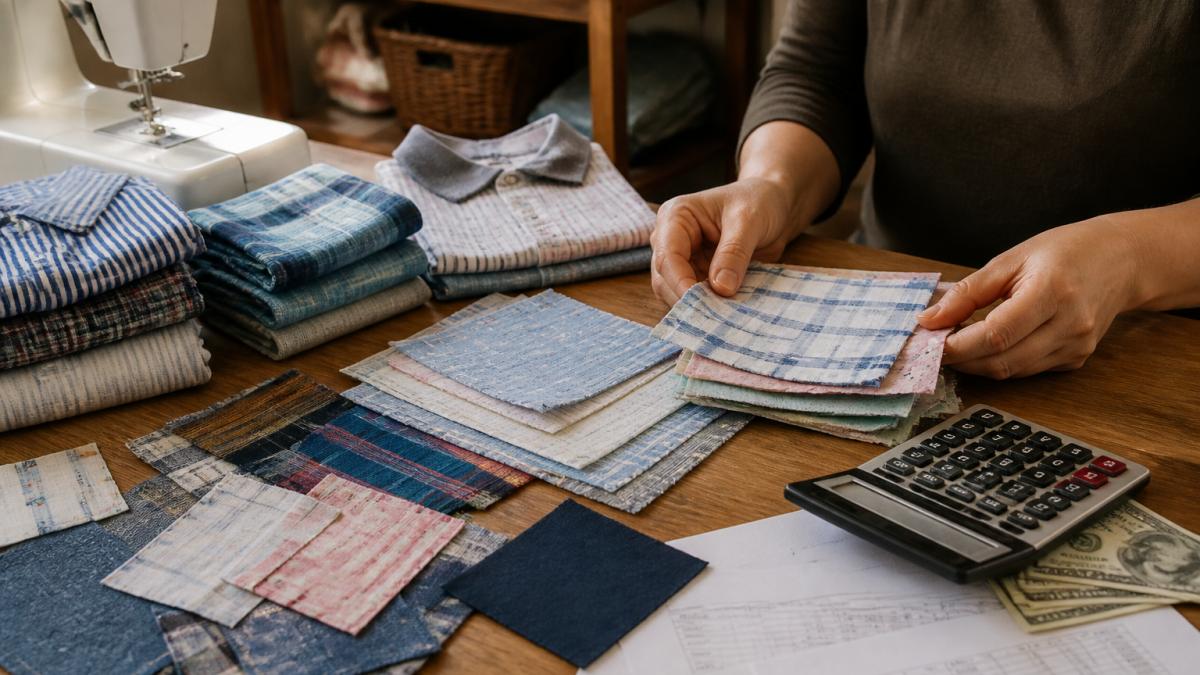
Keepsake Fabric Prep and Handling
Keepsake fabric needs more care than store-bought yardage: stains, worn spots, and thin knits limit usable fabric, so more garments are needed to reach the finished size. Label every garment as it arrives, numbering and logging each piece protects both sides and makes returning unused garments easy.
For a full walkthrough on packing and sending clothing, read the guide to sending clothes for quilts.
Turnaround, Deposits, and Revisions in Your Quote
Time and payment terms belong in the quote, not a separate email. State them clearly and stick to them.
Turnaround time. Handmade work takes weeks, not days.
Revisions. Allow one or two rounds of design approval before cutting begins. After that, changes cost extra because the fabric is already cut.
Watch out: promising a fast turnaround you can't hit damages trust more than a longer, honest timeline. Quote the real number.
Order a Keepsake Quilt With a Quote You Can Trust
A fair price starts with a maker who shows the math. For the full process, follow this step-by-step guide to commissioning handmade memory items.
At Johnson Heirloom, every keepsake quilt is handmade to order, never mass-produced.
Want to see what a real handcrafted heirloom looks like before you commit? View the Custom Heirloom Quilt Handcrafted by Johnson Heirloom to benchmark quality and price.
Get started with Johnson Heirloom and turn a loved one's clothing into an heirloom your family keeps for generations.
Frequently Asked Questions
How much should I charge for a handmade memory quilt?
Start with your actual costs, then add labor and margin. For a throw-size keepsake quilt, materials like batting, backing, binding, and coordinating cotton often run $60 to $120, and longarm quilting adds more. Add your hourly labor for cutting, piecing, and finishing, then apply a profit margin of 25 to 40 percent. A finished 65-inch throw from a professional shop typically lands in the $350 to $850 range depending on size, pattern, and customization.
What costs should go into keepsake quilt pricing that makers forget?
Most makers remember fabric and batting but skip the hidden costs: longarm quilting fees, thread and needles, pattern licensing, shipping both ways, payment processing fees, packaging, and the unpaid hours spent emailing customers and prepping garments. Add a line for overhead too, such as machine maintenance and studio space. A quilt pricing calculator that only counts materials will always produce a number below what the work is worth.
How do quilt size and design complexity change the price?
Size sets the base. A 42-inch baby quilt needs roughly 4 dress shirts, while a 106-inch XL bed quilt needs about 25, so both fabric and labor climb fast. Design complexity adds more: a Sawtooth Star block takes more cutting and piecing than a simple patchwork grid, and photo panels, embroidery, or incorporated pockets and buttons each add handling time. Price the size first, then add for customization.
Should I charge extra for sentimental clothing or custom embroidery?
Yes, and you should explain why. Keepsake garments need fabric preparation, stabilizing, and careful handling because they cannot be replaced if a piece is cut wrong. That risk and time justify a customization fee. Embroidery with names, dates, or quotes adds machine time and setup. Itemize both on the quote so the customer sees the value rather than a single unexplained total.


