

7 Steps to a Memorial Quilt From Loved Ones Clothes
Last Updated: October 25, 2026
Quick Summary
A memorial quilt is made by cutting meaningful garments into fabric pieces and stitching them into a quilt you can hold and pass down. Most need between 4 and 25 garments depending on size, and you should wash, photograph, and sort clothes before cutting. Plan your size first, then cut, stabilize, piece, layer, quilt, and bind.
- A baby quilt needs 4 shirts, a throw 9, and an XL bed quilt 25.
- Photograph each garment front and back before you cut anything.
- Use a ¼-inch seam allowance and a common 6½-inch block size.
- Cut backing and batting at least 4 inches larger on every side.
- Custom quilts start at $500 with 6-8 weeks turnaround after clothes arrive.
Table of Contents
- What a Memorial Quilt From Loved Ones Clothes Really Is
- Clothing Required for a Memory Quilt: How Many Shirts and What Works
- How to Prepare Clothes for a Memory Quilt Before You Cut
- Memory Quilt Patterns That Showcase Meaningful Garments
- Sizing, Layout, and Garment-Count Planning Before You Sew
- Step-by-Step Construction: Cutting, Piecing, and Quilting
- How to Care for a Memory Quilt So It Lasts Generations
- Ordering a Custom Memorial Quilt From Johnson Heirloom
- Frequently Asked Questions
What a Memorial Quilt From Loved Ones Clothes Really Is
A memorial quilt from loved ones clothes is a handmade keepsake made by cutting meaningful garments into fabric pieces and stitching them into a quilt. It turns everyday clothing into something you can hold, use, and pass down.
At Johnson Heirloom, we've spent over eight years making these quilts by hand, and we've learned one thing above all: the clothes are the point. Not the pattern. Not the thread count. The shirts.
Why Clothing Makes a Different Kind of Keepsake
Photos sit in albums. A quilt sits on your couch.
Fabric holds memory in a way images can't. A flannel shirt still smells faintly of sawdust. A baby onesie still has that soft, washed-a-hundred-times feel.
That's why a memorial quilt often helps more than a framed photo during the grieving process. It gives your hands something to do and your body something warm to hold.
Clothing Required for a Memory Quilt: How Many Shirts and What Works
Most memory quilts need between 4 and 25 garments, depending on the finished size and the pattern. Bigger shirts give you more usable fabric, so fewer are needed.
Here's a simple planning table we use when customers ask how much clothing to send:
| Quilt Size | Finished Size | Dress Shirts Needed |
|---|---|---|
| Baby | 42" × 42" | 4 shirts |
| Throw | 63" × 63" | 9 shirts |
| Large Throw | 63" × 84" | 12 shirts |
| Bed | 84" × 84" | 16 shirts |
| XL Bed | 106" × 106" | 25 shirts |
Good clothing choices include:
- T-shirts and polos for soft, casual quilts
- Dress shirts for structured star patterns
- Sweaters and knits for warmth, though they need extra stabilizing
Watch out: heavily worn, stained, or thin garments may not survive cutting.
How to Prepare Clothes for a Memory Quilt Before You Cut
Wash everything first, then sort by fabric weight and color before you make a single cut. For practical guidance on sending clothes in, see Tips for Sending Clothes for Quilts: A Complete Guide.
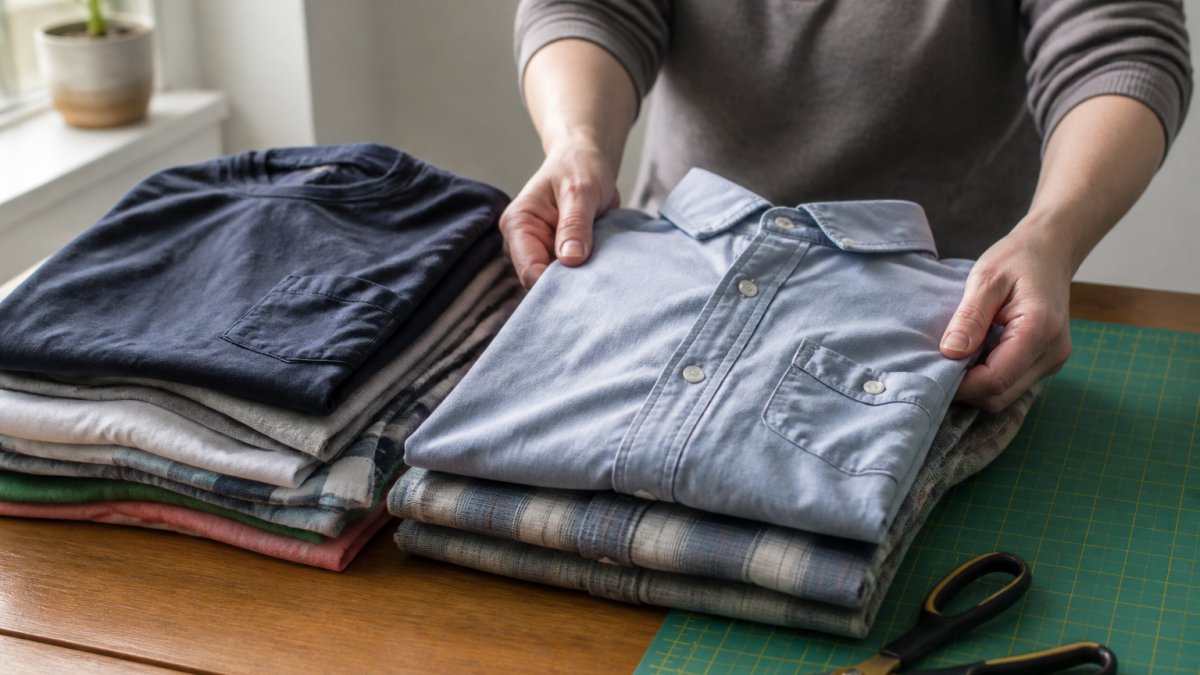
Sorting, Washing, and Stabilizing Sentimental Clothing
Follow this order:
- Photograph each garment first. Lay every item flat and take one clear photo of the front and one of the back. If a piece is later damaged or you change your mind about the layout, the photo preserves the memory and helps a quilt maker match colors.
- Test-wash one delicate item before washing the whole pile. Use your normal detergent, cold water, and no fabric softener. Fabric softener leaves a residue that interferes with fusible interfacing and can cause skipped stitches. If a garment has never been washed, a uniform, a wedding shirt, a jacket, wash it alone first and check for color bleed and shrinkage.
- Check for damage and note it. Look for stains, holes, thin spots, and fraying at collars and cuffs. Circle problem areas with a safety pin so you remember to cut around them. Set heavily worn or stained pieces aside for a pillow or a small accent square rather than a full quilt block.
- Sort by fabric type and weight. Keep stretchy knits (jerseys, polos, sweaters) away from stiff woven cottons (dress shirts, uniforms). Mixing weights in one quilt causes uneven seams and puckering. Sort into three piles: lightweight wovens, midweight wovens, and knits.
- Cut out the keepers before anything else. Remove and save pockets, buttons, monograms, embroidered logos, name tapes, and patches. A chest pocket with a pen stain can become a focal square. Buttons can be sewn onto the finished quilt as a label or keepsake.
- Stabilize stretchy fabric. Iron lightweight fusible interfacing onto the back of knits and jerseys before cutting. Without it, jersey curls at the edges and stretches out of shape under the needle. Cut interfacing slightly smaller than the fabric piece so it does not gum up your iron.
Handling Delicate, Bulky, and Irreplaceable Fabrics
Some garments need special handling before they reach the cutting mat:
- Sweaters and knits: Do not cut through a sweater's ribbed bands or thick seams. Felt the sweater first by washing it in hot water and drying it on high, which shrinks and locks the fibers so it cuts cleanly. Test on a single sweater before committing the whole pile.
- Silk, satin, and slippery fabrics: Back them with a lightweight fusible interfacing before cutting. Slippery fabric shifts under a rotary cutter and produces crooked squares.
- Uniforms and heavy workwear: Remove patches, badges, and name tapes with a seam ripper rather than cutting through them. Heavy twill and canvas dull rotary blades quickly; change the blade before starting.
Memory Quilt Patterns That Showcase Meaningful Garments
The best memory quilt patterns are simple ones that let the clothing do the talking. Busy patterns hide the fabric. Clean patterns show it off.
Three layouts work well for most families:
- Sawtooth Star - traditional star blocks that frame dress shirt fabric. Our Custom Sawtooth Star Memory Quilt | Made from Loved One's Dress Shirts | Handmade Keepsake Quilt shows how plaids and stripes look inside each star.
- Simple patchwork - equal squares in a grid. Fast, forgiving, and great for mixed clothing.
- T-shirt quilt - large centered panels that keep whole logos and graphics intact.
Sawtooth Star, Patchwork, and T-Shirt Quilt Layouts
Pick based on what you're working with:
Custom Memory Quilt (made from clothes) →

- Dress shirts and uniforms: Sawtooth Star
- Mixed everyday clothing: Patchwork
- Graphic tees and team shirts: T-shirt quilt panels
A common mistake is choosing an intricate pattern for your first quilt. Start simple. The fabric is the story, not the geometry.
Sizing, Layout, and Garment-Count Planning Before You Sew
Plan your finished size before you buy batting or backing. Most families want a throw they can actually use, not a wall hanging.
Work backward from the size:
- Decide the finished dimensions.
- Divide by your block size to get the block count.
- Add 15% extra fabric for trimming and mistakes.
Lay the cut pieces on the floor in the planned layout. Step back and look. Swap pieces until the colors balance. Take a photo of the final arrangement so you can rebuild it at the machine.
Step-by-Step Construction: Cutting, Piecing, and Quilting
Construction moves in a fixed order: cut, stabilize, piece, layer, quilt, bind. Skipping ahead causes puckers and crooked seams, and the mistakes compound with every step.
Here is the sequence with the specifics that matter:
- Cut uniform squares. Use a rotary cutter, a self-healing mat, and a quilting ruler. A common block size for memory quilts is 6½ inches square, which finishes at 6 inches once seamed. Cut all pieces to the same size; a single off-size square throws off an entire row. Replace your rotary blade before starting a project with heavy fabrics.
- Stabilize any stretchy pieces. Fuse lightweight interfacing to the back of knits before cutting. For T-shirt quilts, cut the graphic panel with a ½-inch margin, fuse interfacing, then trim to the final block size.
- Piece blocks in rows. Use a ¼-inch seam allowance throughout. Sew blocks into rows first, then sew rows together. Press seams to one side as you go, pressing open weakens the seam in a quilt that will be washed. Pin at every intersection so corners line up.
- Assemble rows into the full quilt top. Lay the completed top flat and check that it is square by measuring both diagonals; they should match within ½ inch. Trim any excess.
- Layer backing, batting, and top, then baste. Cut backing and batting at least 4 inches larger than the quilt top on every side. Use a low-loft cotton batting for a keepsake quilt that will be used, or a higher-loft polyester batting for a puffier look. Baste with curved safety pins every 4 inches, or spray-baste in a well-ventilated area.
- Quilt through all three layers. Simple straight-line quilting on a grid or in the ditch of the seams is the most forgiving method for a first quilt. Free-motion quilting allows custom designs but requires practice. Quilting density matters: read the batting package, because most battings specify a maximum distance between quilting lines (often 4 to 10 inches) and will shift or clump if quilted too sparsely.
- Bind the edges to finish. Cut binding strips 2½ inches wide, sew them to the front, fold to the back, and hand-stitch or machine-stitch the back edge. Miter the corners for a clean finish.
Fabric-Specific Challenges and When to Get Help
- Stretchy knits: Always interface before cutting. Sew with a slightly longer stitch length and a walking foot if you have one.
- Bulky seams: Where several heavy fabrics meet, trim the seam allowance to ⅛ inch and press the seam open to reduce bulk. A denim needle handles thick twill and canvas.
- Slippery fabrics: Baste or pin generously, and consider a temporary fabric adhesive spray.
A finished memory quilt is not a competition entry. A slightly crooked seam in a quilt made from a father's flannel shirts is still a quilt made from a father's flannel shirts.
How to Care for a Memory Quilt So It Lasts Generations
Wash a memory quilt gently and rarely. Spot clean when you can, and use cold water on a delicate cycle when you can't.
Keep it lasting with these habits:
- Wash cold, on gentle, with mild detergent
- Skip the dryer; air dry flat
- Store folded in a cotton bag, out of direct sun
Ordering a Custom Memorial Quilt From Johnson Heirloom
When you're ready to hand it off, ordering is straightforward. If you'd like a step-by-step walkthrough of commissioning a handmade memory item first, see How to Commission Handmade Memory Items: A Step-by-Step Guide.
Our Custom Memory Quilt (made from clothes) starts at $500, and typical turnaround is 6-8 weeks from the business day after your clothing arrives. Add at least 2 weeks per additional quilt in the same order.

We know sending a loved one's shirts to a stranger feels risky. Every package is logged on arrival, and we work only from your garments. No mass production, no substitutions.
Frequently Asked Questions
How do you make a memorial quilt from a loved one's clothes?
Start by choosing garments with sentimental value, then wash and dry them fully. Cut away seams, collars, and stained areas, and stabilize stretchy fabrics with fusible interfacing. Cut uniform squares or pattern pieces, arrange the layout, and sew them into rows before adding batting and backing. You can finish it yourself or send the prepared clothing to a quilt maker. Johnson Heirloom's Custom Memory Quilt starts at $500 and typically takes 6-8 weeks after your clothes arrive.
How many shirts or clothing items do you need for a memorial quilt?
It depends on the finished size and the pattern. As a guide, Johnson Heirloom's Sawtooth Star dress shirt quilt needs 4 men's large or bigger shirts for a 42" x 42" baby quilt, 9 for a 63" x 63" throw, 12 for a 63" x 84" large throw, 16 for an 84" x 84" bed quilt, and 25 for a 106" x 106" XL bed quilt. Smaller or heavily worn garments may require extras to make up the usable fabric.
Can you make a memorial quilt from different types of fabric?
Yes, but mixed fabrics behave differently. Cotton and flannel press and sew easily, while knits, polyester, and wool stretch or fray. Back stretchy pieces with fusible interfacing before cutting, use a slightly longer stitch, and keep similar weights grouped within a block. Quilt makers routinely blend dress shirts, T-shirts, and sweaters in one quilt, supplementing with coordinating quilting cotton when a garment yields too little usable fabric.
How do you care for a quilt made from sentimental clothing?
Wash it rarely and gently. Use cold water on a delicate cycle with a mild detergent, then tumble dry on low or air dry flat. Store the quilt out of direct sunlight, folded with acid-free tissue in a cotton pillowcase rather than a sealed plastic bag. Rotate the fold lines every few months to prevent permanent creases, and spot clean small marks instead of washing the whole quilt.
If you've been staring at a closet full of clothes you can't bear to part with, that's the sign to start. Johnson Heirloom builds each quilt by hand, made to order, with custom sizing, pattern choice, and optional embroidered names or dates. Get started with Johnson Heirloom and turn those shirts into an heirloom your family can wrap up in for generations.


